


Female age and fertility
New short video about Anti-Müller-hormone AMH (in German)
General facts about fertility and age
It is still too little known that fertility of a woman starts to decline after 30 years. This decline accelerates dramatically at an average of 37 years, whereafter fertility is virtually non-existent after 42 years. The menstrual cycle becomes shorter when the woman approaches forty years and gets irregular later on. This biological sequence relates to the diminishing ovarian reserve (stock of eggs), which is some half a million at birth but decreases quite fast, without regenerating the eggs by cell division like men do with sperm. At an average age of 51 years, menstruations stop altogether, which is called menopause.
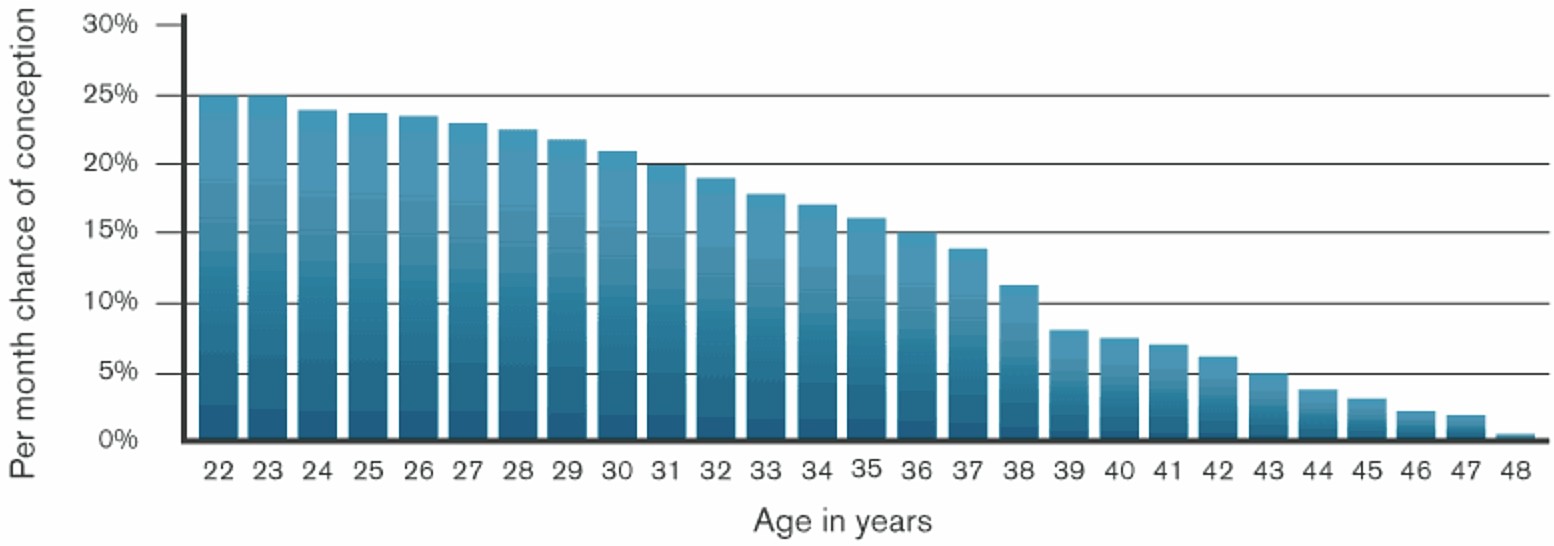
Above: Probability of conception in a natural cycle of a couple without fertility problems. Mankind is fertile year-round, albeit with quite modest efficiency. The drop in women has a quantitative component (measurable by AMH level, and differing from one woman to another) and a qualitative one, which is determined by age alone.

Above: Development of AMH levels over the fertile lifespan of women - huge individual differences, but only slow decline with age. As mentioned in the video above, natural fertility is completely independent from AMH, as long as ovulations take place.
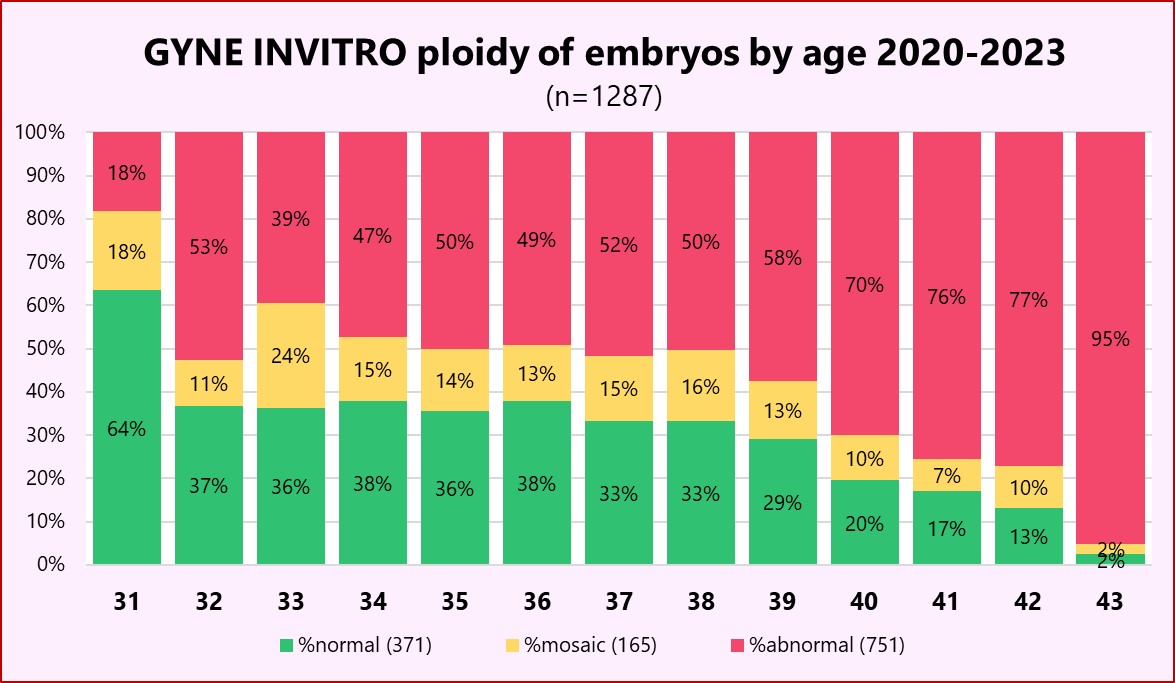
Above: Regarding the qualitative component, our biologist can confirm the quite dramatic decline of genetically normal embryos with age (green columns). With pre-implantation testing, we can avoid transferring embryos without a chance, but the problem of the biological clock is not resolved in a sustainable manner. It is preferable to start a family earlier!
Risk factors for premature ovarian ageing |
|
Consequences |
|
Assisted reproduction like IVF does NOT compensate for aged and/or too little eggs!